Enterprise Storage: Dedicated Systems vs. Open Source – From Isolated Pools to a Storage Cloud
16 Dec 2025 · architecture, enterprise-storage, infrastructure, opensource, platform-architecture, core2code
Enterprise Storage: Dedicated Systems vs. Open Source
From Isolated Pools to a Storage Cloud as a Knowledge Base
Enterprise storage was long treated as passive infrastructure.
Provision volumes. Plan pools. Optimize performance.
Reliable. Predictable. Invisible.
That model no longer holds.
Data is no longer static. It is analyzed, combined, automated. It flows between systems, platforms and teams.
Storage is no longer neutral infrastructure. It has become part of the organization’s knowledge layer.
And that changes the question.
It is no longer simply dedicated enterprise storage or open source. It is about the architectural and operational model that enables future data usage at all.
Core Theses
- Storage is evolving from isolated pools into a logical storage cloud.
- Data is a knowledge base, not just a resource.
- Dedicated systems optimize stability; open source optimizes integration.
- The real decision is about architectural and operational maturity.
Storage as a Knowledge Base
Modern architectures place different demands on storage.
Data is consumed by multiple systems in parallel. Access happens through protocols and APIs. Workloads are dynamic and often containerized. Traceability, versioning and security are mandatory.
Storage now influences how knowledge is created inside an organization.
Not just where data lives matters. But how it can be accessed. How it can be combined. And how understandable it remains.
Once multiple systems consume data at the same time, storage becomes an architectural component.
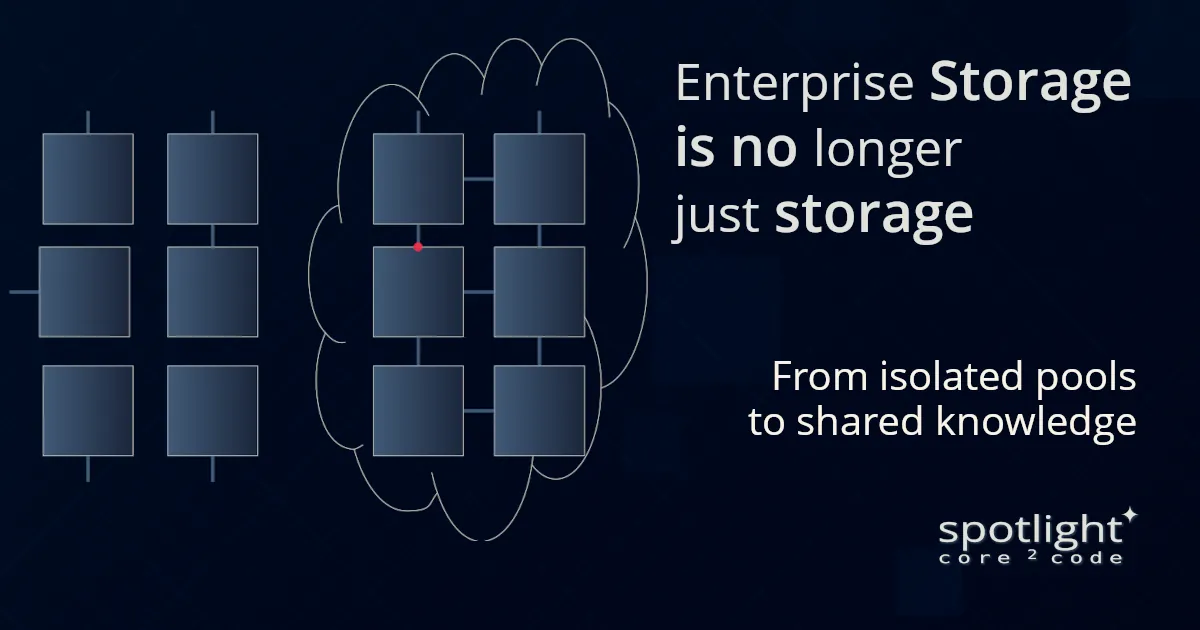
From Storage Pools to a Storage Cloud
The traditional model is familiar.
One application. One storage pool. Clear boundaries.
It simplifies operations. It limits integration.
The storage cloud follows a different principle.
A unified logical data layer. Physically distributed, logically integrated. Multiple access patterns to the same data. Strict separation between data and access layers.
A storage cloud is not a product category. It is an architectural model.
Data is treated as a platform. Not as the property of individual applications.
Dedicated Enterprise Storage
Dedicated enterprise storage systems are optimized for stability.
Clear support models. Predictable behavior. Mature management tooling.
This works extremely well as long as storage remains an isolated unit.
Architectural limits appear once storage is expected to act as a data backbone.
Extensibility beyond predefined use cases is limited. Cloud-native integration is often secondary. Data remains tightly coupled to the system.
Dedicated storage is reliable. But rarely adaptable.
Open Source Storage as a Platform
Open source storage follows a different logic.
Distribution instead of centralization. Integration instead of isolation. Transparency instead of black boxes.
Systems like Ceph, MinIO or ZFS-based architectures are designed for platform integration from the start.
Horizontal scalability. Clear separation of hardware and software. API-centric access. Strong alignment with modern platform architectures.
They are well suited as the foundation of a storage cloud.
The trade-off is not technical. It is organizational.
Open source requires ownership. Operational discipline. And a willingness to build internal knowledge.
Operational and Knowledge Models
The fundamental difference is not technological. It is structural.
| Dimension | Dedicated | Open Source |
|---|---|---|
| Responsibility | external | internal |
| Adaptability | limited | high |
| Integration | system-centric | platform-centric |
| Knowledge building | outsourced | internal |
| Dependencies | vendor | organization |
Dedicated systems reduce operational responsibility. They shift it outward.
Open source increases responsibility. And makes it visible.
Both are valid. But the consequences are very different.
Architectural Maturity
Open storage architectures require prerequisites.
Clear ownership. Experienced infrastructure or platform teams. Understanding of distributed systems. Long-term investment in skills.
Without these, open source does not increase freedom.
It increases risk.
In such environments, dedicated storage is not a conservative choice, but a deliberate one.
Conclusion
The decision between dedicated enterprise storage and open source is no longer an infrastructure choice.
It is a decision about responsibility. About knowledge. About dependencies.
Dedicated systems reduce operational responsibility by shifting it outward.
Open source increases responsibility and makes it visible.
Both are valid. Only one supports a shared knowledge base.
Designing storage as pools optimizes existing structures. Designing storage as a cloud is a deliberate choice for agency.